
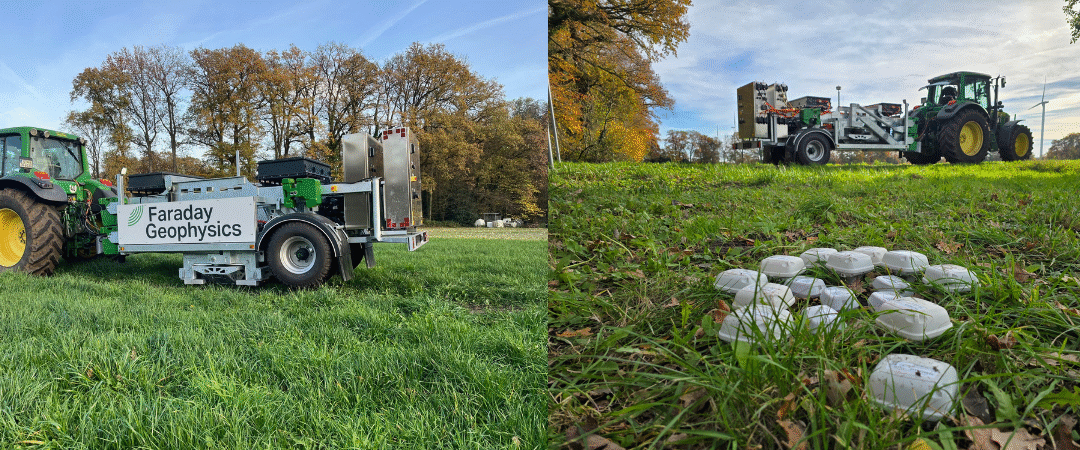
Over the past weeks, our team has taken two important steps forward in validating the URGENT solutions. Conducting our first small-scale field trial provided valuable insights, confirmed key design choices, and highlighted opportunities for refinement as we move toward larger-scale validation.
Our initial small-scale field test brought several encouraging results. The setup included two Evibes/Eboxes supported temporarily by a two-screen interface. While effective, this will soon transition into a more streamlined single-screen setup.
One major success was the synchronous shooting performance of the Hurricane eVibe, which worked exactly as intended. We reported excellent visibility and smooth, intuitive handling, confirming that the control and positioning concepts are on the right track.
Despite using a larger tractor than would typically be ideal, due solely to availability on the day, the manoeuvrability remained practical. A smaller tractor will be perfectly suitable for the 3.5-meter trailer in future tests. To further enhance safety and visibility, we also added a Faraday-branded board, which proved effective during operation.
We followed up the test by testing our MEMS receivers from Innoseis with the hurricane eVibe from Seismic Mechatronics. This trial aimed to gather initial data under field conditions while keeping the setup intentionally limited in size and complexity.
The configuration included:
- 5 nodes, allowing straightforward comparison
- Side-by-side testing of geophone and accelerometer nodes
- A short receiver line with clustered node placement
- An eVibe sweep from 1 to 80 Hz, lasting 30 seconds
- Two vibration points per shot point
Even at this small scale, the results were encouraging. The data offers early validation of our approach and provides a baseline for adjustments ahead of larger deployments.
Next steps
With the small-scale trial completed, preparations are already underway for the next major step: a larger field test with approximately 50 nodes, scheduled for late January. This will allow us to assess system behavior at a more realistic operational scale and gather more comprehensive performance data.
These milestones mark a meaningful progression from concept to field-ready technology.
 English
  Hungarian
  Polish
  Dutch
Dutch  French